
Kaçkar Traverse – Turkey
Totals: 8 Days, 261.1 miles, 43h 10m, 53,392 ft


Short Stories from Along the Way
Words and Photos - Josh Conroy
Riders - Joey Schusler, Jimmy Smith, and Josh Conroy
Rather than attempt a play-by-play of our time in the Kaçkar Mountains, these words take shape as a few short stories — glimpses of the people we met and the places we passed through. They don’t account for every mile or moment, but they create space to talk about our interactions with both the people and the landscape. Through them, we hope to offer a clearer sense of the hospitality, generosity, and patience shown to us, often without a shared language.
These stories aren’t always jaw-dropping, but they reflect just a handful of the many meaningful encounters we had during our short time in the Kaçkars. Over 261 miles, the landscape shifted constantly — from jagged peaks to wide glacial valleys to rolling high-elevation plateaus that felt closer to desert. We expected the route to be difficult, but we didn’t anticipate the subtleties of the terrain or the rhythms of daily life high in these mountains.
The Kaçkars are home to numerous ethnic groups, their histories layered over one another — yet across those differences runs a common thread: a slower pace of life shaped by elevation, weather, and necessity.

Mertcan
One moment we were skirting the Black Sea while driving from Trabzon to Ardeşen; the next, we were climbing straight into lush green foothills with the Kaçkar Mountains rising behind them. The range lifts abruptly here, pushing forests, farms, and villages right to the water’s edge. The valleys funnel inland from the coast, dense with beech, alder, and chestnut trees. The slopes are stitched with tea fields and small plots carved in the terrain wherever possible. In the Rize region where we started, tea (or çay in Turkish) is more than a crop. It’s the structure of daily life. Many hillsides are planted in tea, harvested by hand, and tended by families who have worked the same slopes for generations.
Our route was dictated by an artificial line on a map. From satellite images on Google Earth and Gaia, it’s hard to tell whether a pale slash across a hillside is a trail, a scree slope, or just erosion. Lucky for us, Joey is an expert in big trips in foreign mountains like this. While his experience in the Kaçkars was none, his experience in route-finding where others have not ridden gave us hope.
The Kaçkars hold one of the largest populations of brown bears in the region, along with wolves, lynx, wild boar, eagles, and the massive dogs used by herders to guard their flocks. Weather moves quickly here. Clouds form and dissolve in minutes as moisture from the Black Sea is pulled inland and forced upward.
We started riding just after dawn from the edge of the sea, following a two-lane road that climbed alongside the Fırtına River. Morning in this part of Turkey unfolds slowly. Tea steamed from roadside shops, farmers moved deliberately through small fields, and the road stayed quiet as we worked our way uphill. With nothing open at 6 a.m., we rode with the intention of finding food further up the way, covering ten miles before stopping. They would be the easiest miles of the day. The further inland we went, the steeper everything became.
We stopped at the first place that was open and looked good.
Breakfast arrived in metal dishes. Muhlama, a melted cheese, butter, and cornmeal dish, was at the center of the table, surrounded by bread, honey, olives, vegetables, and tea. There was menemen too: eggs scrambled with peppers, tomatoes, cheese, and generous amounts of butter. In the mountains, meals move at the pace of tea. Cups are constantly refilled, and leaving too quickly feels almost impolite. These restaurants feel less like businesses and more like extensions of someone’s home.
Mertcan, the owner’s son, sat with us and talked. He told us about his family, the restaurant, other parts of Turkey he loved, and the honey we couldn’t stop eating. His English was impressive. He asked questions about our route, listening carefully before shaking his head. Like many people we met, he didn’t quite understand what we were doing. He said he wouldn’t go up there himself. Not because of distance, but because of bears and weather. Still, he was curious and wanted to follow along on our journey via Instagram.
As we gathered our bikes, Mertcan and his father noticed our cameras and waved us upstairs where he gave us a tour of his camera collection. A collection of vintage film cameras hung from the wall held in old leather cases. It seemed like he was trying to communicate that these once belonged to his father. Back outside, they picked hazelnuts from the tree out front and showed us how to crack them open with a pliers. Few words were exchanged, but it didn’t matter. They handed us fruit, nuts, and honey. Then pointed toward the hillsides where they came from. I felt like I had a friend showing us around their home, rather than out to eat at a restaurant.

This was our first encounter after starting the ride. On paper, it was a small, unplanned stop. A shared meal, a few gestures and short conversations with the help of Google Translate and body language. But in a foreign place, without the language and with only a rough understanding of the mountains ahead, it carried real weight. They were generous and patient. Food appeared without us quite knowing what to ask for. Curiosity moved both ways, calm and unforced. There was no urgency to send us on our way. What they offered was local knowledge and kindness, grounded in a sense of community; one that felt more like a reflex than a favor, where generosity carried no weight because it was shared freely and often.
It was the first of many moments like it. A quiet introduction to a humble and kind hospitality that exists in these mountains. It was the beginning of a long journey for us, but for them, just another morning at home in the mountains.

Come On, Bro
Five days into the route, we had settled into a new baseline. What had felt daunting at the start of massive climbs, long bike carries, and hours spent gaining a single ridge was now routine. Our legs had ridden themselves into shape, and our minds had slowly detached from anything beyond the simple loop of climbing, crossing, and descending. We became more accustomed to spending four hours gaining a ridge with bikes on our backs, only to drop into the next valley in twenty minutes.
That day, we hedged our bets on a small detour into a tiny yayla, hoping to find a market for some Cokes and snacks. Before coming to Turkey, I’d never heard the word “yayla,” but it simply means a highland pasture. An area of multiple highland pastures is referred to as “yaylalar.” By the end of the trip, the word would be inseparable from the experience — a place families move to in the summer to escape the heat, tend animals, and live simply. It’s a rhythm older than roads, shaped by elevation and weather rather than schedules. Life up there moves slowly, deliberately, without urgency.

The valleys that hold these places are often vast and glacial – some of the most striking landscapes I’ve ever seen. Tucked into them are small clusters of wood and stone houses with metal roofs. Up higher, shelters become more temporary with stacked rocks for walls, sometimes with just a tarp stretched over the rocks. The herders who live there seemed content, unhurried, and curious in a quiet way. I don’t think they had ever seen mountain bikes in these valleys. They either didn’t bat an eye or would wander over to talk, explaining what they did up there, where they moved their animals, and how long they stayed.
There were moments when we’d stand next to a herder in silence, grateful simply for the shared presence. No effort to communicate, and no need to. It felt like acknowledgment. A wordless welcome, and a reminder that connection doesn’t always require language. Other times, people went out of their way to invite us into their homes, offering food and tea without hesitation. We couldn’t accept every invitation, or we would not make it as far as we needed to each day, but the pace and simplicity of life in the yaylas left a pull to slow down that was hard to ignore.
This valley was no different. Above the yayla, the landscape opened up. The jagged peaks surrounding Kaçkar Dağı, the highest peak in the Kaçkar Mountains, gave way to a softer, more glacial feel — still high and alpine, but more rounded and rocky. The valley was wide and green with ridgelines bulbous, covered in rock. From a distance, we saw a man who had noticed us and was already walking in our direction. The rugged dirt road passed close to his house, and for a moment we wondered if he was coming to tell us we couldn’t be there.
But from our experience, that was never how it went in the Kaçkars. Herders spoke of the valleys they watched over, but never with a sense of ownership. The land didn’t seem to be claimed in the same sense that it was back home.
When we met him, it was clear that he was simply curious. His name was Ahmet, and he wanted to know what we were doing up there with bikes. When he invited us to his home, we tried to politely decline. He insisted, so we followed.
He walked us to his house with his dog alongside him. A friendly, medium-sized mutt with a black-and-white coat. Ahmet was eager to show us his freshwater spring, rigged with PEX plumbing that fed straight from the hillside. The water was clean, cold, and refreshing. We usually filtered our water to play it safe, but drank freely from springs and rivers throughout the trip without issue.
We sat in the shade of his roof for a few minutes before he looked at us and asked, “çay?” We said yes. By that point we were fully on board with the tea culture. That’s when he gathered his things and started walking back down the driveway, which confused us. We assumed something had been lost in translation. Then he pointed toward the top of the valley, up at the pass, and said it again: “çay?”
Still unsure, we agreed and started moving. It became clear he wanted to have tea at the top of the pass. He was on foot, and we were on bikes. It was steep and still a long way to go.
We should have known better how minimal of a task this was for him. Judging by how quickly he descended from his cattle when we first saw him, Ahmet moved through these mountains with ease. A few whistles and shouts toward his herd seemed enough to settle them while they stayed near the base of the col. We started pedaling, determined not to dismount while Ahmet hammered up the face of the slope. The grade sat right on the edge between rideable and walkable, with the grass thick and clumped. Ahmet kept hammering uphill, black backpack on his shoulders, and staff in hand.
It’s easy to tell the difference between people recreating in the mountains and those for whom the mountains are simply the way of life. For Ahmet, movement through this valley wasn’t an activity – it was his existence. He knew every contour and moved across the land effortlessly.
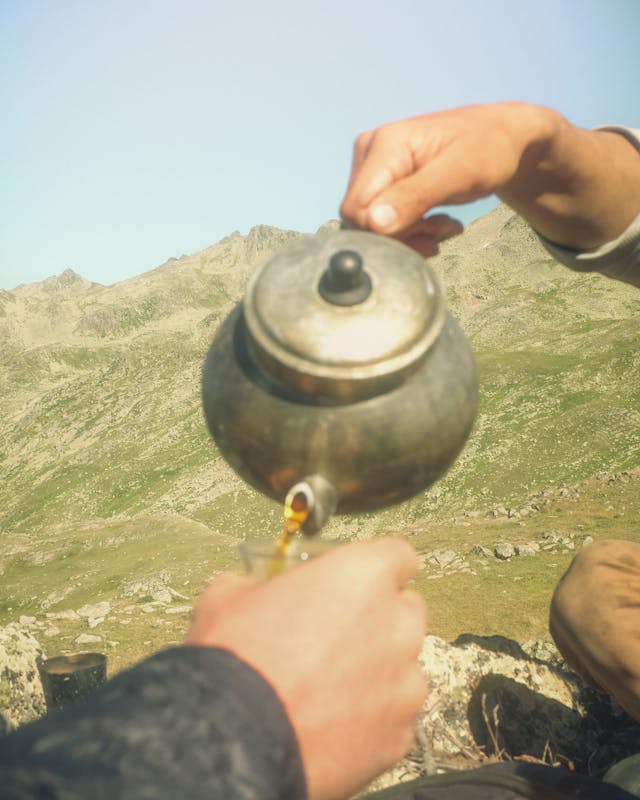
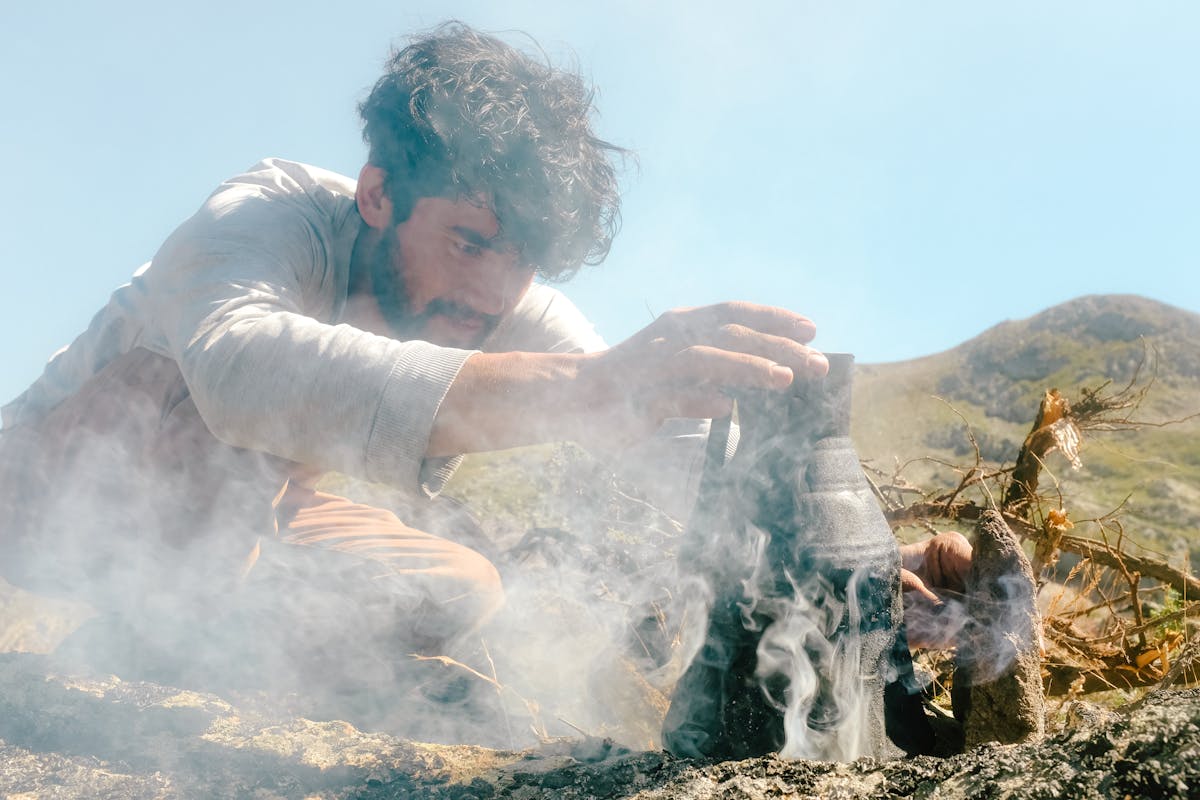
Near the top, where the valley opened into a broad overlook where he stopped and said ‘çay’ once more. He waved us over and unpacked his bag. He pulled out a cast iron pan, butter, cheese, and cornmeal – everything needed for muhlama. He then pulled out a Turkish tea kettle, walked down to a nearby creek about 60 yards away for water, and then gathered kindling from bushes in the treeless valley.
He cooked while we watched. We ate muhlama with bread as the tea steeped. When it was ready, he handed each of us a traditional Turkish tea glass – wide at the top, narrow in the middle, and wide again at the base, looking almost like a small flower vase. He raised his glass and said, “Come on, bro.”
We all laughed. It was the first English he’d spoken, and the only English he knew. For the rest of the afternoon, it became our shared language. Each time he offered us more food or tea, he’d say it again. Come on, bro.

Stained Hands
We were coming off several long days moving through the most jagged and relentless terrain of the trip – the kind that drains you while you simultaneously become more accustomed to it. We dropped down a long valley into a town without a restaurant. We knew we would need more calories soon but were unsure where they would come from.
Another yayla appeared halfway up the climb, above the valley floor rather than at its base like most we had come across so far. As we rounded the corner, we saw a family sitting outside. There were kids playing in the grass. As soon as they noticed us, they waved us over, asking us to join them for tea.
Multiple families were out conversing. Jimmy rolled down to greet them, which effectively made the decision for all of us.
We sat outside first, acknowledging one another’s presence more than speaking, showing videos on our phones when they asked about what we were doing. They shook their heads and laughed. When they asked if we wanted tea and food, we agreed without hesitation.

We walked down a path to a short set of stairs that ran along the side of the house to a wooden door. The roof was layered with wood and packed dirt, with grasses growing up through it. Inside was a single room, roughly fifteen by fifteen feet, accounting for the entire living space. Simple, but complete. A wood-burning stove sat against the wall beside the kitchen area. A small wooden table served as a food preparation area, and a twin bed folded out from the wall. They directed Jimmy and me to sit on the bed, while Joey took a small stool opposite the table.
The first thing they brought was a large bowl of watermelon. Then dishes we didn’t recognize. An older woman prepared fresh muhlama over a small stove in the center of the room while we ate. Several of them had purple-stained fingers, something we’d noticed often in the mountains. The hillsides here are thick with blueberries and other wild fruits. Stained hands were a sign of the season.
They asked about our route and how we’d even found this place. We stumbled through conversation while learning about each other as best we could. Some of the family lived in Istanbul during the winter and came up to the yayla each summer, usually from June through August. They were planning to head back down that day. Others would stay a few weeks longer, stretching the season as long as weather would allow.
We ate slowly. Tea was poured without asking, and time loosened its grip once again.
By the time we stepped back outside, fed and hydrated with tea, the urgency we carried up the climb had dissolved. What we had been measuring in terms of distance, daylight, and calories had been replaced by the kindness and hospitality they showed us. Once again, in a place where we shared almost no language, we’d been welcomed without hesitation.


Generous Revelation
By the end of the route, it was no longer possible to separate the mountains from the people who lived among them. The Kaçkars revealed themselves through repetition. Fog rising and falling. Passes gained and lost. Meals shared without ceremony. What stayed with us wasn’t just the scale of the terrain or the difficulty of the route, but the way life here moved in step with the land.
Again and again, we were met with a generosity that felt woven into daily life. It was simply offered through long tea breaks and food shared. In places where the mountains dictate so much, community felt less like a choice and more like a survival skill. What people shared with us came freely and without expectation, grounded in the understanding that everyone, at some point, depends on someone else.
Trails appeared and disappeared, and the fog blurred distance and scale, reminding us how little control we actually had.
For us, this was a journey. But for the people who live here, it was simply life. A seasonal rhythm of moving up and down, working within limits set by terrain and climate, knowing when to push and when to wait. A place to learn from quietly, and to leave with humility.
The mountains remained, indifferent to our passing. But we walked away with a deeper respect for slowness, and shared effort.


Jimmy’s Daily Notes:
Day 1: Climb from Ardeşen to the Base of Kackar Dagi
Strava Link
32.92 mi, 5:29:28, 7,641 ft
- Breakfast with Markesh
- Grocery stop (should have stocked up more)
- Long, busy road climb
- Photo stop at the “Heart” — parrots in the background
- Arab veil sighting - No corn
- Turned away at a hotel
- First night: three deep in the tent, weird sleep continues
- Leftovers for dinner
- Warm Skratch before bed


Day 2: Big Push into the High Country
Strava Link
22.92 mi, 4:26:09, 6,400 ft
- Started with a massive 2.5k hike-a-bike
- Reached as close as we’d get to Dağı
- Shoe broke halfway up
- Passed alpine lakes
- Sick technical descent on the far side
- Hikers reassured us about route ahead — they’d been scouting guided rides, had even seen Joey’s films
- Huge cheese-pull breakfast in the valley town below
- Knocked out three big dirt passes that felt easy after the morning effort
- Met an old man speaking Las while searching for lunch
- Cruised into Yaylaköy, panicked lunch → wandered into the coolest lodge yet
- Showers, beers, light soup for dinner, actual beds
- Down by 8pm, up by 5am


Day 3: High Passes & Village Hospitality
Strava Link
18.55 mi, 5:41:55, 6,145 ft
- Woke up refreshed and clean
- Breakfast at lodge, packed leftovers
- Chill dirt climb with good convo (cartoons, Gen Z work ethic)
- Trail over a 9k saddle marked by cairns
- Encountered sheep and barking dogs → shepherd from Afghanistan called them off. Shared Nerds Clusters with him.
- More sheep/dogs after the pass, again called off
- Boulder field hike, then fun descending into villages
- Invited in for tea and lunch by village women — watermelon, muhlama, yogurt with fresh berries. Refused payment. Best meal yet.
- Contrast: incredible hospitality → then the sketchiest sidehill trail ever (life-or-death exposure). Dropped out early, steep ridge descent, rejoined route.
- Camped by the river above the valley. Dinner: bread, honey, butter.
- Tomorrow: first of the five prongs.


Day 4: Into the Prongs
Strava Link
19.39 mi, 5:04:34, 5,610 ft
- Coffee, bread & honey breakfast
- Up and over the first prong — met guys fishing/chilling by a lake
- Big push over another pass, fun descent into town
- No restaurant → grumpy shop clerk. Cold orange soda, one bag of chips, candy stash
- Climbed into mist on second prong, 20 ft visibility, dogs barking in the fog. Shepherd shearing sheep called them off.
- Long dirt road descent to highway, soaked and starving
- Found bungalows across the valley — got a room
- Showers, lodge dinner, tea with the owner
- Joe lit a fire, Josh nearly set his shammy ablaze on the stove
- 8pm bedtime in warm beds


Day 5: Encounters with Ahmed
Strava Link
30.06 mi, 5:24:53, 6,421 ft
- Coffee & breakfast at bungalow
- Long road climb over the 3rd prong, good vibes
- Village tea stop → pressed onward
- Rough climb up the 4th prong
- Met shepherd Ahmet (age 21) and his dog Tony. Shared spring water, guided us to an overlook, built a fire, made tea and food. Surreal experience.
- Ahmed owns 100 cows, summers here, winters in Trabzon. Wanted to hang longer, but we pushed on.
- 6,000 ft descent: open field riding like carving on snow.
- Josh lost his phone, recovered it with Find My — bonus grass descent round two.
- Ended with killer BBQ, then found a roadside camp.
- Joey slept under the stars; Josh and I shared the “honeymoon suite” tent.


Day 6: Toward Uzungöl
Strava Link
27.90 mi, 3:43:15, 4,961 ft
- Woke damp in cow pasture under power lines
- Tea at BBQ spot; man building across street gifted us cheese
- On the climb: fruit & yogurt drink from a man who’d been to Universal Studios (2013)
- Gel + house music = flying up final 2,500 ft
- Sidehill trail & singletrack descent → massive road descent to Uzungöl
- Town felt like “Arab Silver Thorn” — crowded, hot, not our vibe
- Mediocre hotel and dinner. The yaylars are calling


Day 7: Toward Sultan Murat
Strava Link
34.72 mi, 5:31:50, 8,652 ft
- Quick hotel breakfast, steep push after road washout
- Bread & cheese gift mid-climb, then more yogurt drink and a perfect hand pie from a family en route
- Reached Sultan Murat plateau → big meat dinner, resupply at store
- Camped near cows; herder stopped by asking for a cigarette


Day 8: Heat & Weariness
Strava Link
31.71 mi, 4:08:20, 5,174 ft
- Köfte sandwich breakfast
- Long, hot road climb into mist
- Tea and cigarettes with locals
Worst hotel of the trip


Day 9: Return to Trabzon
Strava Link
42.89 mi, 3:40:07, 2,388 ft
- Left terrible hotel ASAP
- Foggy morning, great light
- Short climbs, free-riding, then bomber dirt descent to Masca
- Highway grind back to Trabzon
- Shower, packed bikes, pizza lunch plus chef’s sampler of traditional food
- Indian dinner, beers, sports betting in the room
- Solid sleep 😴


Definition Ready
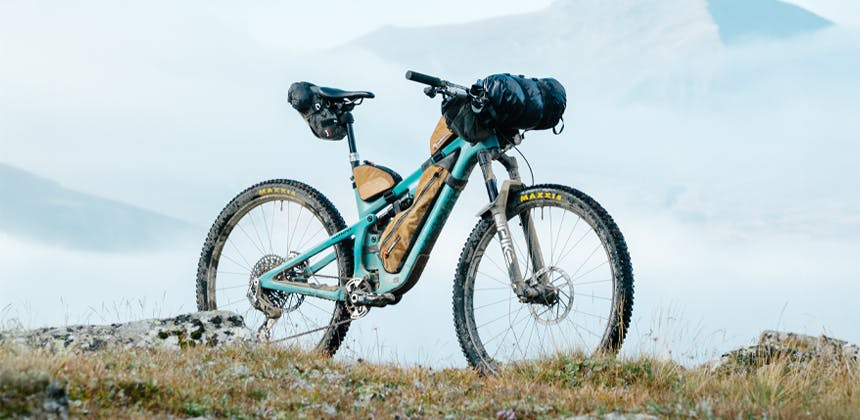
The 2026 SB120 is pure short-travel trail perfection. Made for explorers, backcountry wanderers, and those who can’t resist one more summit, even when the light’s fading. It doesn’t know the word ‘done’.